Tuesday, March 20, 2018

Mycenaean Swords and Daggers with Riveted Handles

All photos taken by Phil Baumhardt at the National Archaeological of Athens (Greece).
Artifacts from Grave Circle A and B in ancient Mycenae. 


Bronze knife with ivory handle riveted to blade


Saturday, March 3, 2018

Viking's Companion Coilspring Knife

You can view the "making-of" videon on Youtube: https://www.youtube.com/watch?v=v2fSJb8TbOE


Pouch style sheath

Finished blade without handle

Blade is black after the quench. Knife needs its final grind to shape and temper.


Checking the blade fit to the handle, as well as aesthetic balance.

Finished knife


Viking era knife from Hedemark (Norway); inspiration for my knife.

Friday, February 9, 2018

Viking Saxes with Drop Points (Museum Photos)

It seems that there are a great many people who think that a "Viking" knife had to have a sheepsfoot/wharncliff type point.  From my research, this blade style seems to have been found mainly in England, which leads me to the conclusion that the type of blade associated with Scandinavians warriors are in fact Anglo-Saxon in origin.

Here are a few photographs from museum collections in Norway: http://www.unimus.no/arkeologi/#/collectionView?

Example from Ringerike 
Telemark

Nordland

Romsdal

Nordland

Saturday, January 13, 2018

How Did Vikings Carry Their Knives?

Many re-enactors wear their scramasaxes horizontally on their belts, and the only evidence that I can find for this is two stone carvings.
From a stone cross in Middleton Church, North Yorkshire, England.


Some archaeological examples of Viking knife sheathes with the rings for horizontal carry.


Ukrainian find, 2006 Shestoviskaja graveyard dig

Sunday, December 3, 2017

Viking Knives with Elongated Drop Points- Norwegian Finds

C12739 (Oppland)

C52968, Cultural History Museum of Norway

From Nord-Trøndelag (Norway)

From Nord-Trøndelag (Norway)
Find T15139A, from Nordland, Norway

C34843, from Oppland, Norway

C32500, from Oppland, Norway:  "Sverdkniv"


C21340a, from Oppland, Norway.  Spearheads and knives.


Sunday, November 5, 2017

Plate-Brynie

In Snorri Sturlason's "Heimskringla", a  the history of the Norse kings, there is mentioned something called a "plate brynie".  This reference comes from a story that is set between 1157 and 1161 A.D.   Now a brynie is of course what we commonly call a chainmail shirt or mail shirt.  So what is a plate-brynie?

From archaeological evidence, there are only two examples that come close in my mind. Both are from Sweden

The first is a grave find from Valsgarde which dates to the Vendel Age (550-793 A.D.): it appears to be a combination of ring-mail and splitted strips of iron that look like they would have been attached to leather straps with rivets.


Multiple pieces of armor found at site of the Battle of Visby (1391 A.D.) are made up of multiple plates riveted together that bears a resemblance to Eastern lamellar armor.  


So for something that fits into the Viking Age (800-1000 A.D.), I came up with this: the plates are linked together with rings and incorporated into the mail shirt as essentially the front of the armor.  While not based on anything specifically historic, I feel that it would be a logical development in armor going from the classic mail shirt to the plate armor that was found in Visby.


Tuesday, June 6, 2017

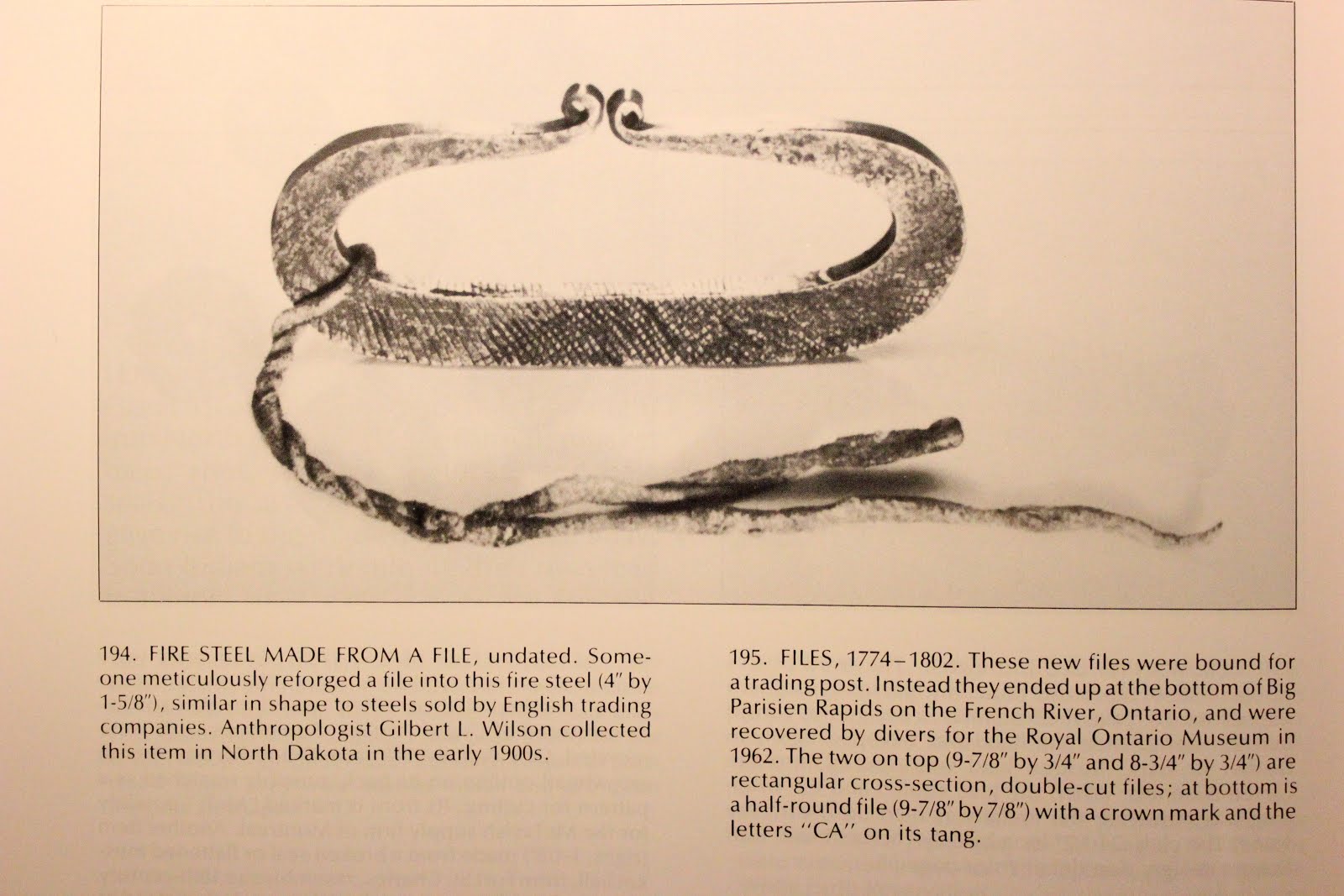
Fur Trade Era Flint Strikers


Pictures taken from the book "Where Two Worlds Meet: The Great Lakes Fur Trade", published by the Minnesota Historical Society.