Showing posts with label German. Show all posts

Saturday, May 9, 2015

German Hunting Swords from the 18th century

Gilt bronze hilt and ivory grip.


The "hunting sword" was an evolution of the "hanger" sword that dates to about 1700.  The blades are shorter and slightly more curved, and the name derives from the motifs that decorate it (such as the bird or hawk on this example).  The hunting sword was popularized in Britain by Admiral John Benbow.

Monday, April 13, 2015

German "Calendar" Sword, 1576 A.D. Century


The guard is a modern reconstruction.

The ricasso and forte. Maker's mark is on the left.


The blade is the one on the top. The deep fuller and wide cutting edges is reminiscent of Viking Age swords.


Friday, April 3, 2015

German Swept-hilt Rapier (1630/40)


If you look closely on the fuller there are thin marks that is actually a maker's mark. It is the infamous "Running Wolf" mark of the blade smiths of Passau.  The mark has been found on blades as old as the 13th century.


Close up of the guard.


Some decorations on the hilt.

On display at the Detroit Institute of Arts.

Saturday, March 28, 2015

Reitschwert (Sword) from Saxony


Sword used by heavy cavalry, reiters, and harquebusiers between the 16th and 17th century in the Holy Roman Empire and Northern Europe.

German sword, dating from 1580 A.D.
The reitschwert is a hybrid between a bastard sword and a rapier.

Leather scabbard.

Possibly silver fittings on grip and guard.

Blade stamp in fuller.

Possibly maker's mark at the end of the fuller.

On display at the Detroit Institute of Arts.

Wednesday, March 25, 2015

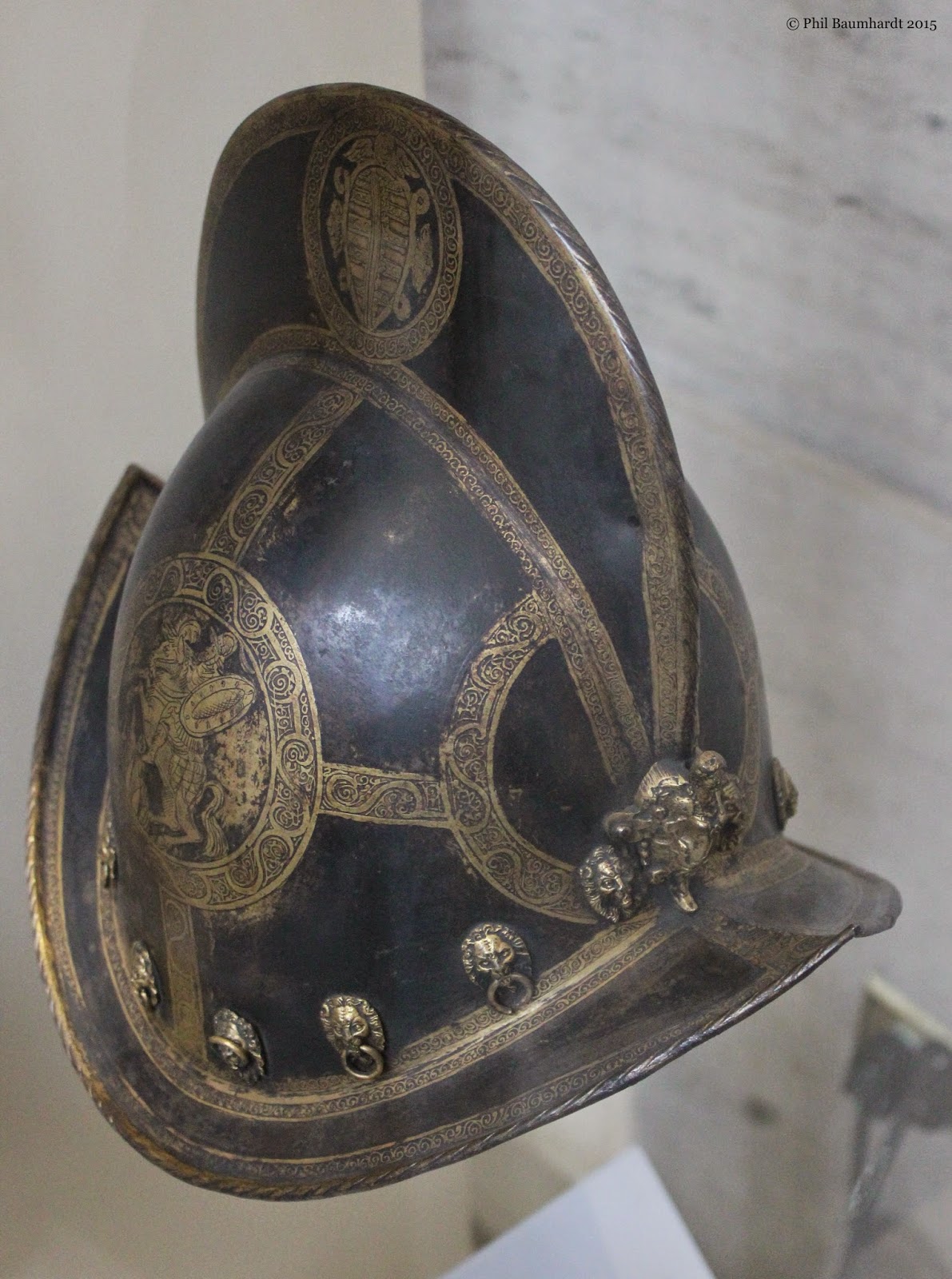
German Morion (helmet) from Saxony (1580/90)

The steel has been blackened, etched and gilded. Beautifully detailed it is obvious that it was never intended to see combat, this was worn by the personal guard of the Prince Electors of Saxony (the Trabantenleibgarde). Black and gold were the livery colors of the electors.

On display at the Detroit Institute of Arts.

Thursday, March 12, 2015

German Wheellock (Firearm)

The DIA has a small collection of beautifully decorated wheel-locks from about 1610.

Impressive inlays with an eagle or gryphon motif that I feel rival that of any other cultures of the time. The large silver eagle's head would hold the piece of flint which would strike the piece.

Plaque at the Detroit Institute of Arts.