Showing posts with label 1600 A.D.. Show all posts

Monday, April 13, 2015

German "Calendar" Sword, 1576 A.D. Century


The guard is a modern reconstruction.

The ricasso and forte. Maker's mark is on the left.


The blade is the one on the top. The deep fuller and wide cutting edges is reminiscent of Viking Age swords.


Sunday, April 12, 2015

Italian Cinqueda (1480 AD)


A broad-blade single handed short sword that is the descendent of Migration and Viking era swords, it was used between the late 15th and mid-16th centuries.  Note the two fullers.

The grip is made from bone.

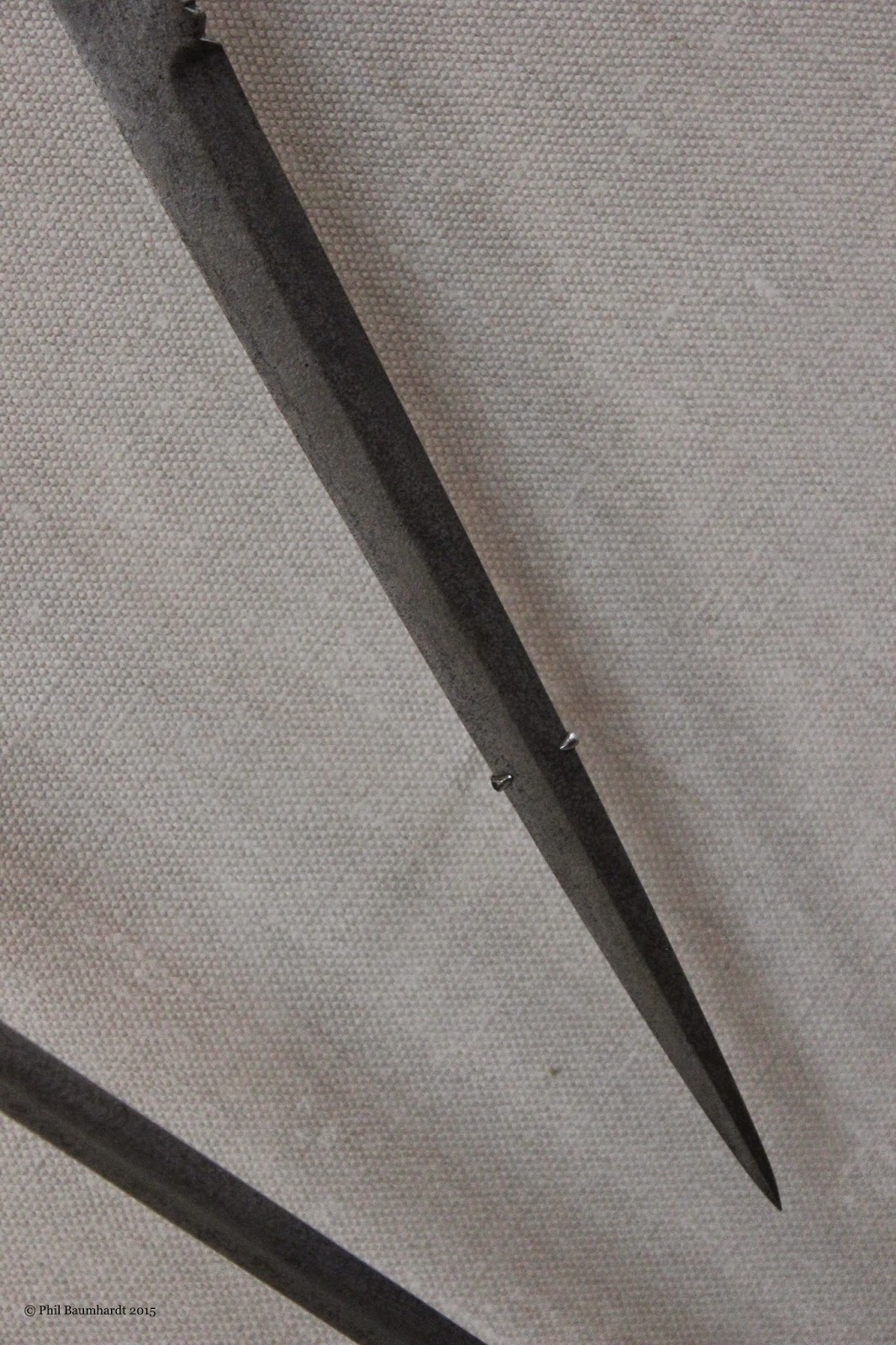
Close up of the cinqueda tip.


Friday, April 3, 2015

German Swept-hilt Rapier (1630/40)


If you look closely on the fuller there are thin marks that is actually a maker's mark. It is the infamous "Running Wolf" mark of the blade smiths of Passau.  The mark has been found on blades as old as the 13th century.


Close up of the guard.


Some decorations on the hilt.

On display at the Detroit Institute of Arts.

Saturday, March 28, 2015

Reitschwert (Sword) from Saxony


Sword used by heavy cavalry, reiters, and harquebusiers between the 16th and 17th century in the Holy Roman Empire and Northern Europe.

German sword, dating from 1580 A.D.
The reitschwert is a hybrid between a bastard sword and a rapier.

Leather scabbard.

Possibly silver fittings on grip and guard.

Blade stamp in fuller.

Possibly maker's mark at the end of the fuller.

On display at the Detroit Institute of Arts.

Thursday, March 12, 2015

German Wheellock (Firearm)

The DIA has a small collection of beautifully decorated wheel-locks from about 1610.

Impressive inlays with an eagle or gryphon motif that I feel rival that of any other cultures of the time. The large silver eagle's head would hold the piece of flint which would strike the piece.

Plaque at the Detroit Institute of Arts. 


Wednesday, March 11, 2015

Italian Main Gauche Dagger with Blade-catch (17th century)

Blade-catching holes run the entire blade-length until it starts to taper toward the point.


The true edge is sharp, even if the back is not.

Interesting wire-wrap on the hilt.

Square holes with elongated corners, which I feel were created for catching enemy sword blades.  Even  an inch or two of the point in the hole would allow the wielder of the dagger to control his opponent's weapon.

The twisted shape of the quillion creates grooves that opponent's blades can fall into, which assists in binding maneuvers.  

The tip.

Face in the scrollwork of the knuckle guard.


Interesting blade stamp/makers mark.

Another shot of the point and blade-catchers.

This dagger can be seen at the Detroit Institute of Arts. Dated to 166, from Naples.

Friday, March 6, 2015

Italian Parrying Dagger (17th century)

Parrying dagger or "main gauche".

The dagger would be used in the left hand with the sword in the right.

There is an interesting cross design on ricasso. And there appears to be two blade stamp/maker's mark.  Some sort of X or star and a sun symbol perhaps.

The sunflower-motif seems to be the same as the sword, which leads me to think they are a pair.


The parrying dagger seems to have better geometry for slicing than the sword.

Half of the true edge (edge facing out) has firework. Rather than mere decoration, I think that the purpose was so that it created the possibility of catching or binding an opponents blade after a parry.

The V notches and the button on the cross guard would help bind an opponents blade. I think that if the right angle and pressure was applied the wielder could take control of a sword by binding it between the firework and the scrollwork on the guard.

The crescent cut-outs are also designed for catching and binding enemy swords. I don't think it was something that they would seek to do, but they could if the opportunity presented itself.

On display at the DIA.

Thursday, March 5, 2015

Italian Cup-hilt Rapier (17th century)


Floral decoration on hilt, possibly sunflowers. An extremely detailed pattern that I have no idea how it would be accomplished.  

Blade marking says "Ihn Solingen". The blade appears to have been made in Solingen, Germany.

Mid-blade of the rapier transitions from a fuller and two tapering edges to a diamond profile.

Rapier tip. The diamond shape makes it extremely stout and a highly effective thrusting weapon. 

This sword is on display at the Detroit Institute of Arts.