Saturday, February 6, 2016

Italian Mosaic Depicting a Norman Warrior


"Mosaic from the destroyed Santa Maria Maggiore Basillica in Vercelli. Italy 11th-12th century"

I found this picture very interesting because I am currently working on a script for a short film about the Norman conquest of southern Italy, specifically the Battle of Civitate.

The fellow on the left looks very much to me like a Norman, due to his kite shield and shirt style. His shoes look like the "Viking" boots similar to the ones found in Yorvik, and his sword and facial hair also seem to lend themselves to the Norman persuasion, though I do not count that as strong evidence. The period that the mosaic is dated to falls into the same time as the Norman activity. They originally came to help fight Saracens, so perhaps that is his opponent to the right.

The depiction of the fighting I do find interesting, however, as it seems that the "Norman" is using his long shield to jam up both of his opponents weapons. With his sword in a high guard, he seems poised to either deliver a fatal thrust to his enemies face or sweep low for his exposed leg.

I also find interest in the concept of kite shield vs round shield. Perhaps this indicates a transitional period of shield use between the two types. Or perhaps the kite shield is truly indicative of his Norman identity.

In any event, I have definitely found this image useful as I work on designing the costume pieces for my film.

Wednesday, July 29, 2015

Feast of St. Olaf: Viking, King, Saint

This day today, the Battle of Stiklestad was fought in Norway in 1030 A.D.  Olaf II of Norway was attempting to reclaim the throne, but he died in the battle and was later canonized by the Church. Today  is "Olsok", the day he is remembered.


Friday, July 17, 2015

Completed fantasy sickle/kama

I forged this from a specific designed that was based on a kusari-gama.  This will hopefully be used in an upcoming short film.


Saturday, June 13, 2015

Forged Fantasy sickle/kama

This is my latest work in progress. It is a weapon commissioned for an independent short film.

Wednesday, May 20, 2015

French Smallsword (1780 A.D.)

While at first glance it may look like a delicate weapon, it is in fact quite deadly.

Gilded hilt.

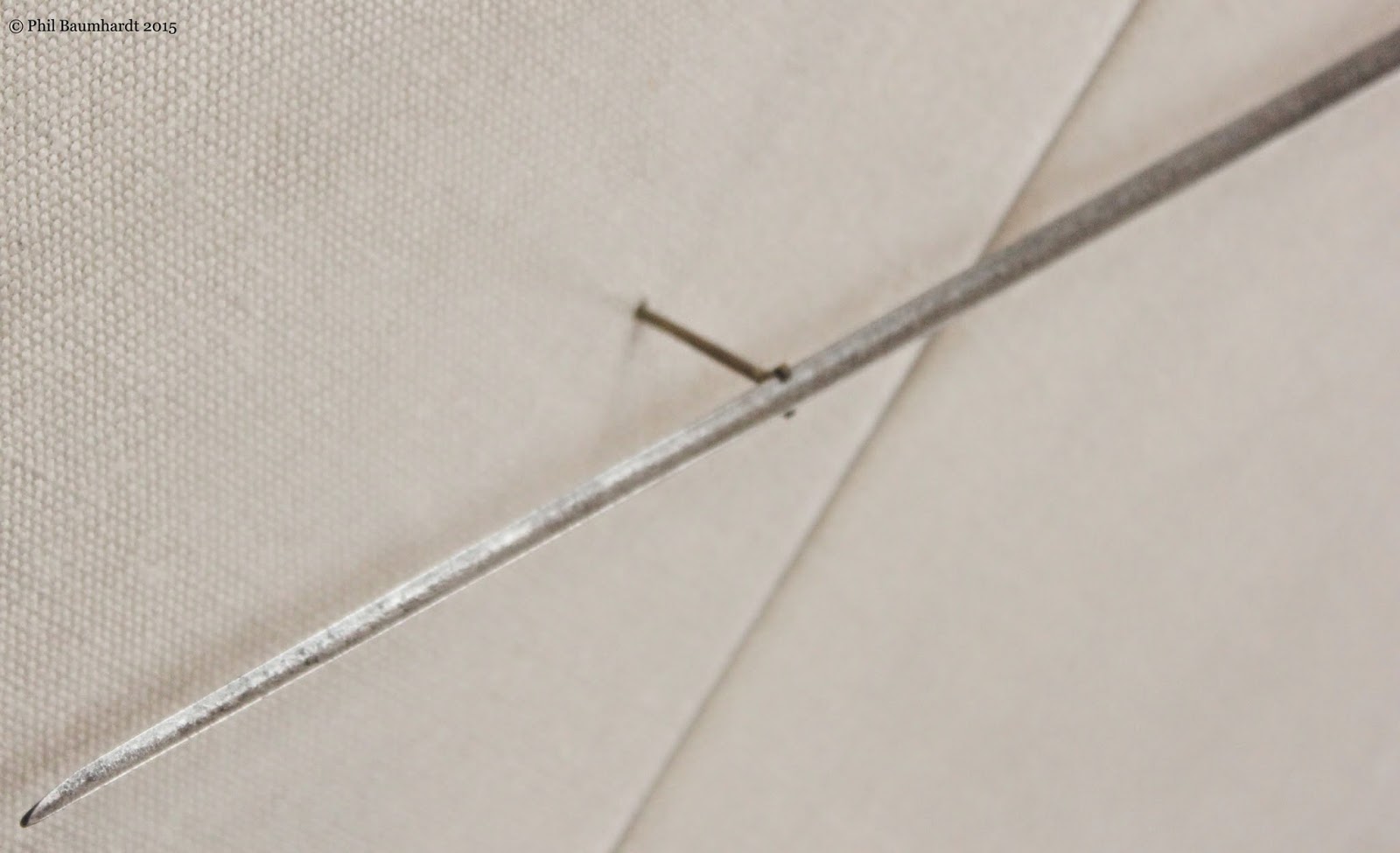
The blade, while lacking a cutting edge, is fluted in what appears to be something of a star-shape, making the sword very rigid and strong.  The purpose of this weapon was to skewer and kill your opponent.

The star-shaped cross section of the blade would leave a horrible wound that have great difficulty healing.  Any thrust to the torso would be a serious and potentially fatal wound, even if it did not instantly strike a vital organ.

The tip of the sword is very strong due to the fluting, and it would puncture heave, layered clothing. It is reminiscent of the chisel-tipped bayonets of the Russian Mosin-Nagant rifles of World-War II.  

The sword is on display at the DIA.

Saturday, May 9, 2015

German Hunting Swords from the 18th century

Gilt bronze hilt and ivory grip.


The "hunting sword" was an evolution of the "hanger" sword that dates to about 1700.  The blades are shorter and slightly more curved, and the name derives from the motifs that decorate it (such as the bird or hawk on this example).  The hunting sword was popularized in Britain by Admiral John Benbow.