Showing posts with label Italian. Show all posts

Saturday, February 6, 2016

Italian Mosaic Depicting a Norman Warrior


"Mosaic from the destroyed Santa Maria Maggiore Basillica in Vercelli. Italy 11th-12th century"

I found this picture very interesting because I am currently working on a script for a short film about the Norman conquest of southern Italy, specifically the Battle of Civitate.

The fellow on the left looks very much to me like a Norman, due to his kite shield and shirt style. His shoes look like the "Viking" boots similar to the ones found in Yorvik, and his sword and facial hair also seem to lend themselves to the Norman persuasion, though I do not count that as strong evidence. The period that the mosaic is dated to falls into the same time as the Norman activity. They originally came to help fight Saracens, so perhaps that is his opponent to the right.

The depiction of the fighting I do find interesting, however, as it seems that the "Norman" is using his long shield to jam up both of his opponents weapons. With his sword in a high guard, he seems poised to either deliver a fatal thrust to his enemies face or sweep low for his exposed leg.

I also find interest in the concept of kite shield vs round shield. Perhaps this indicates a transitional period of shield use between the two types. Or perhaps the kite shield is truly indicative of his Norman identity.

In any event, I have definitely found this image useful as I work on designing the costume pieces for my film.

Sunday, April 12, 2015

Italian Cinqueda (1480 AD)


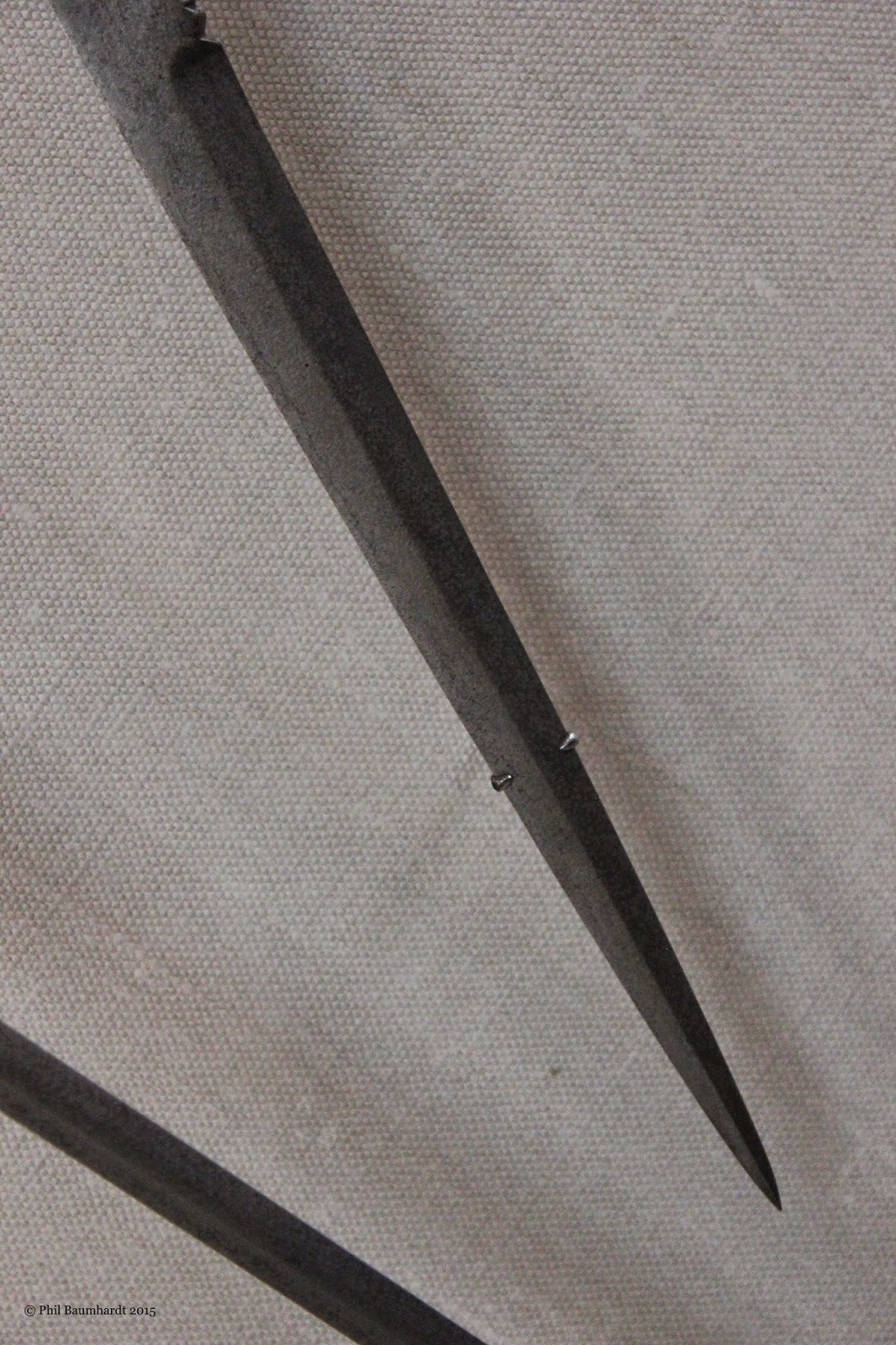
A broad-blade single handed short sword that is the descendent of Migration and Viking era swords, it was used between the late 15th and mid-16th centuries.  Note the two fullers.

The grip is made from bone.

Close up of the cinqueda tip.


Tuesday, March 24, 2015

Italian Barbut (helmet) from 1450/60

While crude looking at first glance, it is still a feat of blacksmithing to think it was forged from a single piece of steel, much like the ancient Greek helm of bronze. This helmet, however, must have been more challenging to make.  The imperfections make it all the more interesting, proof that it was made by a craftsman rather than a machine. 

I imagine that this was a soldier's helmet,  though perhaps it never saw battle. The central ridge and shape of the dome would have assisted in sword/ax blows glancing off the steel and sliding off.


On display at the DIA. 

Wednesday, March 11, 2015

Italian Main Gauche Dagger with Blade-catch (17th century)

Blade-catching holes run the entire blade-length until it starts to taper toward the point.


The true edge is sharp, even if the back is not.

Interesting wire-wrap on the hilt.

Square holes with elongated corners, which I feel were created for catching enemy sword blades.  Even  an inch or two of the point in the hole would allow the wielder of the dagger to control his opponent's weapon.

The twisted shape of the quillion creates grooves that opponent's blades can fall into, which assists in binding maneuvers.  

The tip.

Face in the scrollwork of the knuckle guard.


Interesting blade stamp/makers mark.

Another shot of the point and blade-catchers.

This dagger can be seen at the Detroit Institute of Arts. Dated to 166, from Naples.

Friday, March 6, 2015

Italian Parrying Dagger (17th century)

Parrying dagger or "main gauche".

The dagger would be used in the left hand with the sword in the right.

There is an interesting cross design on ricasso. And there appears to be two blade stamp/maker's mark.  Some sort of X or star and a sun symbol perhaps.

The sunflower-motif seems to be the same as the sword, which leads me to think they are a pair.


The parrying dagger seems to have better geometry for slicing than the sword.

Half of the true edge (edge facing out) has firework. Rather than mere decoration, I think that the purpose was so that it created the possibility of catching or binding an opponents blade after a parry.

The V notches and the button on the cross guard would help bind an opponents blade. I think that if the right angle and pressure was applied the wielder could take control of a sword by binding it between the firework and the scrollwork on the guard.

The crescent cut-outs are also designed for catching and binding enemy swords. I don't think it was something that they would seek to do, but they could if the opportunity presented itself.

On display at the DIA.

Thursday, March 5, 2015

Italian Cup-hilt Rapier (17th century)


Floral decoration on hilt, possibly sunflowers. An extremely detailed pattern that I have no idea how it would be accomplished.  

Blade marking says "Ihn Solingen". The blade appears to have been made in Solingen, Germany.

Mid-blade of the rapier transitions from a fuller and two tapering edges to a diamond profile.

Rapier tip. The diamond shape makes it extremely stout and a highly effective thrusting weapon. 

This sword is on display at the Detroit Institute of Arts.


Wednesday, March 4, 2015

"Satire of a Nobleman in Misery" (18th century oil painting)

This is an Italian painting from the early 1700's that I found interesting because it reminded me of the Spanish film Alatriste (2006).  The movie was an adaptation of Spanish series of novels by Arturo Perez-Reverte, and both works have a lot of sword-fights, knife-fights, etc, so check them out if you're into that type of thing.  Many wide shots from the movie were lit with a single, soft light source such as the sun coming through a window, and I always thought many of these shots looked like paintings.  When I found this period painting that featured the same lighting style, in addition to the drab setting, tattered clothing, and fierce mustache, I couldn't help but think of Diego Alatriste. 

The painting is on display at the Detroit Institute of Arts.
Viggo Mortensen as "Captain Alatriste"


Sunday, March 1, 2015

Swords and Daggers of the DIA

The small collection of blades at the Detroit Institute of Arts.  I have some close-ups of most of the weapons, but this is about the only photo I have that shows the full size and relative scale of each weapon. I plan on uploading detailed pictures of each weapon soon.

Saturday, February 28, 2015

Italian Side-ring Dagger (17th Century)

The dagger would be held in the left hand for parrying, while using a sword in the right.
The side-ring on the guard would protect the outside of the hand (i.e. the knuckle side).

The tip looks sharp as a needle, yet blade geometry keeps it strong. A serious stabbing tool. 

The holes in the fuller illustrate how sophisticated the weapon-smith must have been.


Not sure what the inscription says or means

Impressively elaborate decoration on the side-ring.


This dagger can be seen at the Detroit Institute of Arts.