Saturday, March 28, 2015

Reitschwert (Sword) from Saxony


Sword used by heavy cavalry, reiters, and harquebusiers between the 16th and 17th century in the Holy Roman Empire and Northern Europe.

German sword, dating from 1580 A.D.
The reitschwert is a hybrid between a bastard sword and a rapier.

Leather scabbard.

Possibly silver fittings on grip and guard.

Blade stamp in fuller.

Possibly maker's mark at the end of the fuller.

On display at the Detroit Institute of Arts.

Wednesday, March 25, 2015

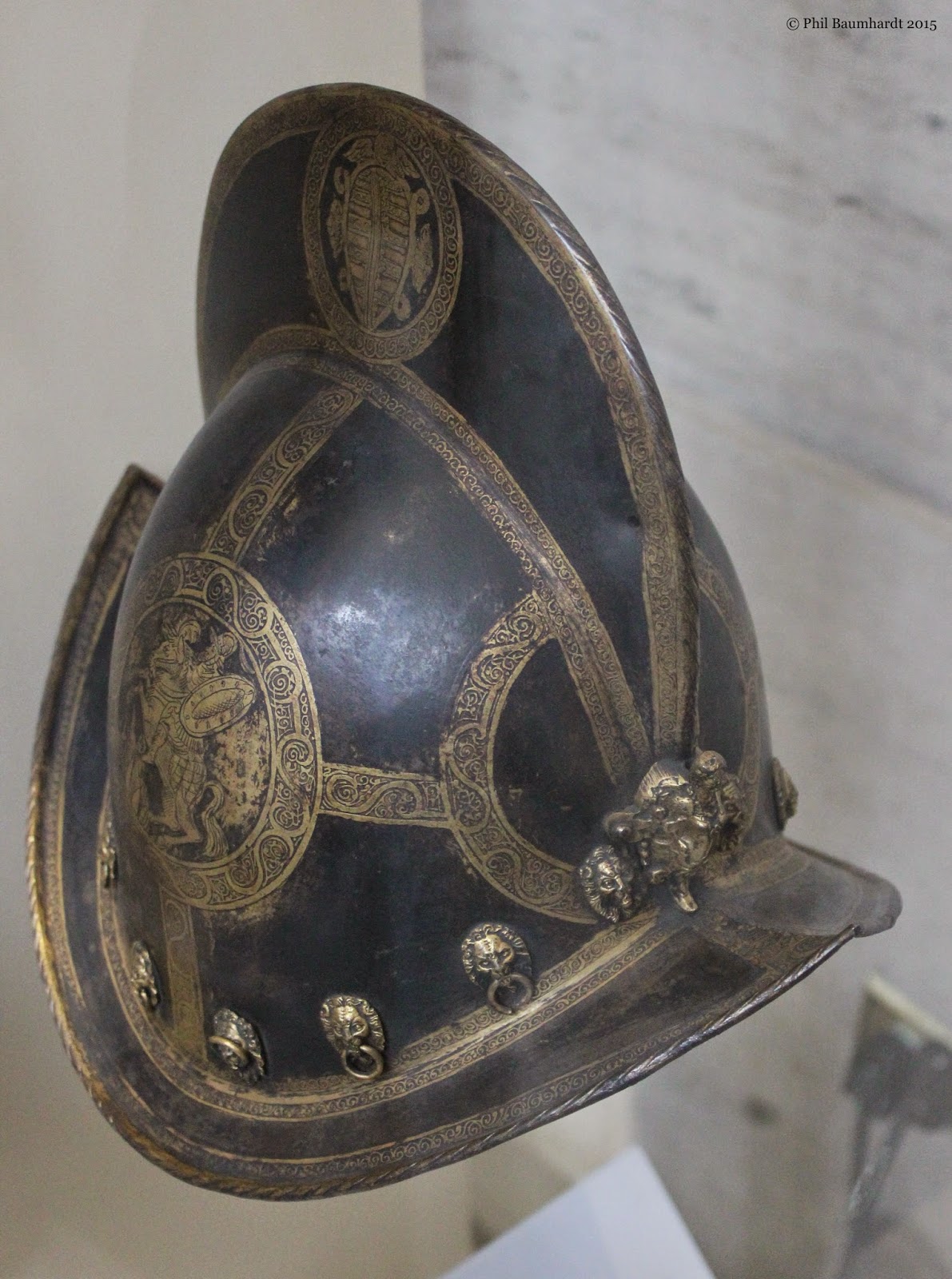
German Morion (helmet) from Saxony (1580/90)

The steel has been blackened, etched and gilded. Beautifully detailed it is obvious that it was never intended to see combat, this was worn by the personal guard of the Prince Electors of Saxony (the Trabantenleibgarde). Black and gold were the livery colors of the electors.

On display at the Detroit Institute of Arts.

Tuesday, March 24, 2015

Italian Barbut (helmet) from 1450/60

While crude looking at first glance, it is still a feat of blacksmithing to think it was forged from a single piece of steel, much like the ancient Greek helm of bronze. This helmet, however, must have been more challenging to make.  The imperfections make it all the more interesting, proof that it was made by a craftsman rather than a machine. 

I imagine that this was a soldier's helmet,  though perhaps it never saw battle. The central ridge and shape of the dome would have assisted in sword/ax blows glancing off the steel and sliding off.


On display at the DIA. 

Monday, March 23, 2015

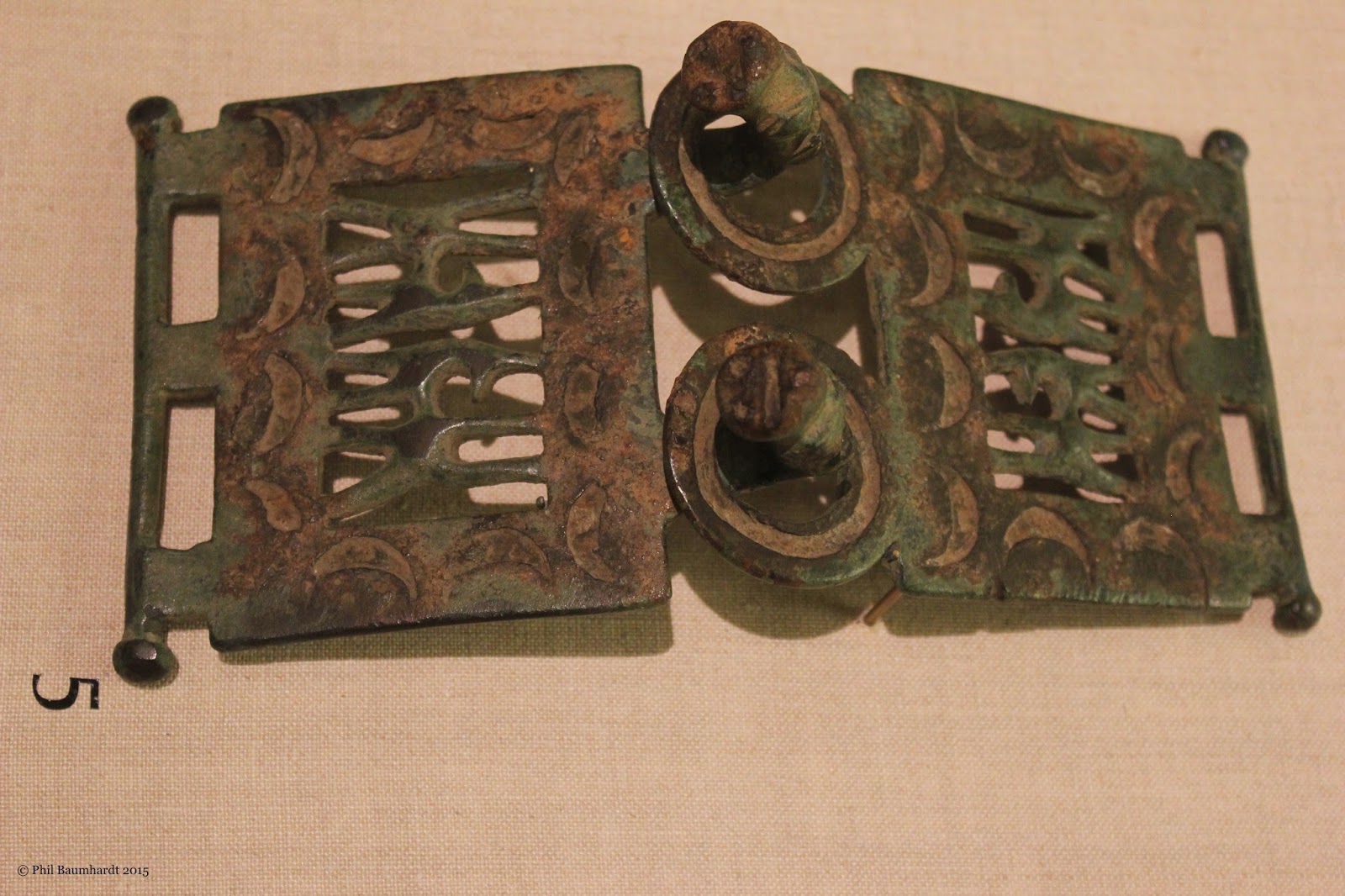
Roman Belt Buckles

Bronze belt buckle from between 700-650 B.C.E.

600s to early 500s B.C.E.

At the Detroit Institute of Arts.

Saturday, March 21, 2015

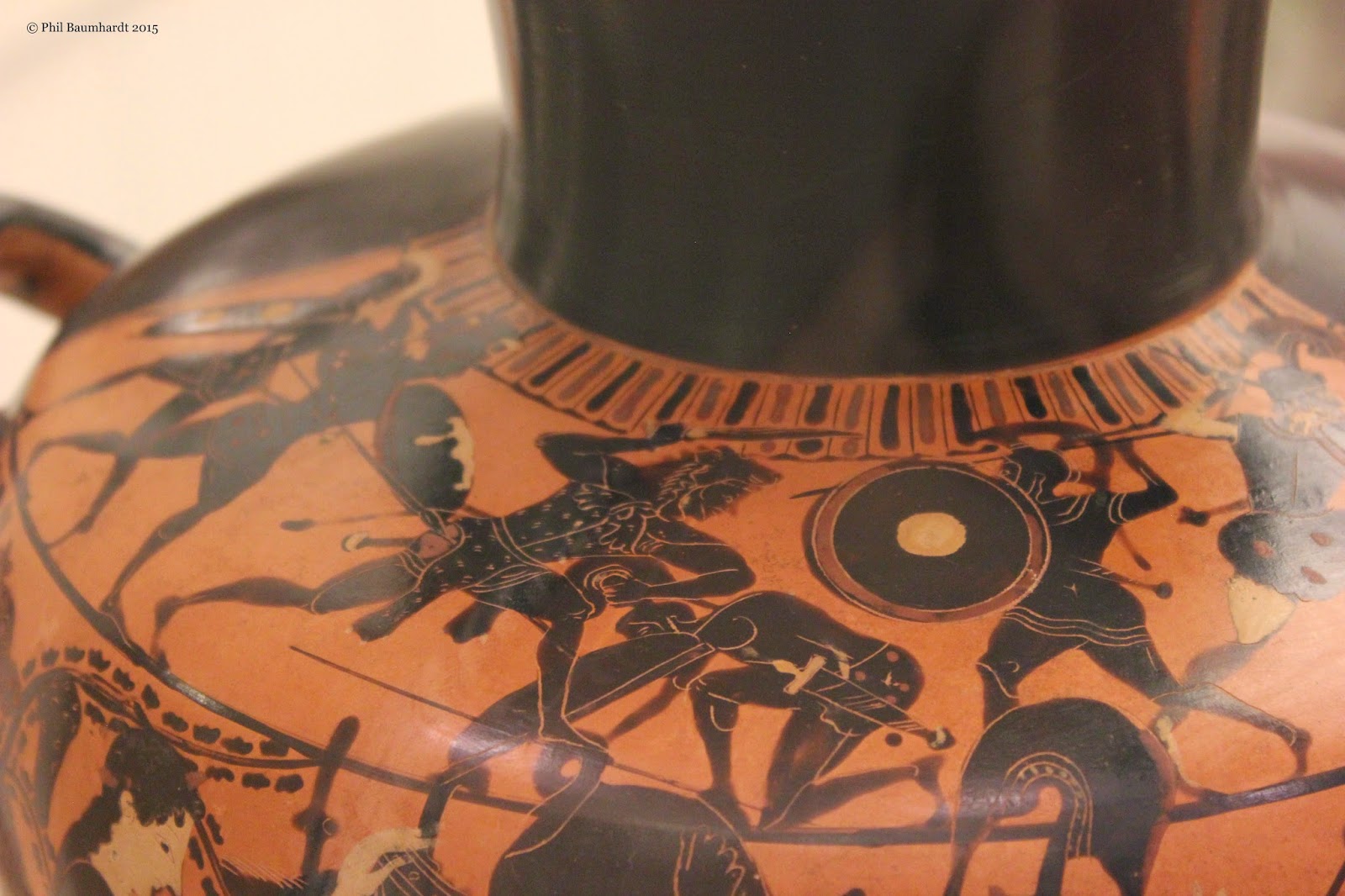
Fighting Technique Depicted on Ancient Greek Amphora

An amphora was a storage jar, dating to around 520-510 B.C.E.
The warrior wearing the leopard/lion skin appears to to exhibiting some close quarters combat skill. He has stepped on his enemy's spear to neutralize it and has gripped the helmet by the crest.  He is also using his elbow to help hold his foe down as he stabs him the back with his sword. Interesting to not the sword is held in a reverse or icepick grip.

Wednesday, March 18, 2015

Roman Votive Altar to Saturn

In Latin it reads, "To Jupiter Sabazius: Quintus Nunninus Alexander has willingly and rightfully fulfilled his vow".

The Romans would make vows to their deity of choice and offer them a sacrifice. Originally it seems that they had a ritual involving the killing of an animal such as a cow or ram and the intestines of that animal would be removed and burned upon an altar.

It doesn't look like this altar was used for this purpose, but rather the carving of the altar itself was the offering made by the man mentioned on the inscription.  The votive ritual appears to almost be a contract between men and the gods, in which the mortal vows to do a thing if the deity does something for him. Here's an in-depth look at the Roman votive ritual: http://www.teachtext.net/bn/ancienthistory/religion_text/Derks.pdf


Display plaque at the Detroit Institute of Arts.

Tuesday, March 17, 2015

Irish-Viking Weapons

Viking weapons found in Ireland. Those are some huge battle axes!

Display at the National Museum of Ireland.